...SIŁA I PIĘKNO MUZYKI TKWIĄ W JEJ RÓŻNORODNOŚCI.
Witamy w cudownym i przerażającym świecie Pyrrhon!!!
PYRRHON łączy różne elementy, aby stworzyć skomplikowane, osobiste napady złości, które uderzają w granice ścisłej akceptowalności gatunku...
I już...
FA
“New York City’s PYRRHON emerge with a mind bending album of surrealistic death metal for fans of Gorguts, Ulcerate & Portal!” Brave words, promo guy, brave words. I as much as I admire your confidence, extraordinary claims require extraordinary evidence. When you invoke Ulcerate and Gorguts in order to hawk your wares, you’ve certainly caught my attention, but lying won’t go unpunished. Besmirching the name of my favorite band of Kiwis is a cardinal sin, so either Pyrrhon has their shit really together, or an overzealous Relapse employee is going to find rat feces in his Cheerios tomorrow.
I’ll spill the important part immediately; The Mother of Virtues is without doubt the most challenging record I’ve heard this year. It took more listening to get used to than From all Purity or Labyrinth Constellation, this year’s previous stalwarts of inaccessibility, and I know for a fact I’m going to be listening to it again and again in an attempt to totally figure out what’s going on. If you’re looking for a puzzle, you can stop here.
There’s really no good way to attack this album in order to appreciate it immediately, but a relatively safe (here meaning least dangerous) place to start would be the bizarre (single?) “Balkanized.” The song is not so much monstrous as it is sociopathic. In the beginning, its absolute violence and angularity jut forth like rusted nails poking out of the splintered floorboards it stands upon. It shuffles and limps like a landmine victim, propelled by a constant rotation of 5/4 and 6/4 rhythms locked in by a tireless bass groove. The second half of the song swaps out the 6/4 for a 4/4, but the bassline never relents, even as the guitars become less dense, meandering dissonantly into the song’s climax. The bloody shout of “It’s not personal!” releases the song’s pent up energy, snapping like like a spring into a tortured waltz before it cleaves itself off. I’ve never heard anything quite like it.
If “Balkanized” isn’t your cup of tea, The Mother of Virtues isn’t your album. It only gets stranger, more abstract and more disturbing in a way that’s not easy to confront. The album is a mix of dark psychedelia, noise, and brutality that constantly shifts from reeling grooves to doomy riffs to pummeling death metal blasts. The guitars, when two are present, often disagree entirely on what to play, constantly screaming out different notes that attack each other through stifling reverb. This appears most prominently on “Eternity in a Breath,” a slow-paced, doomy song that ends in a series of glitches and hisses that, when contrasted with the long song they close off, are viscerally disturbing. I can’t help but cringe and shudder at them.
If “Balkanized” is your cup of tea, Pyrrhon is probably your new favorite band. All of the disorienting guitar work, prominent bass grooving and frenzied, shifting drumming carries over to the rest of the songs, whether in the deathgrind-oriented opener “The Oracle of Nassau” or the intoxicating “Invisible Injury,”,whose ending solo is a work of pure wonder feeding off of the song’s opening motif. The last moments of “Invisible Injury” are the absolute zenith of The Mother of Virtues. That’s not to say that the rest of the album is weak, but it’s this performance that truly drew me in to the album the first time through, convinced me that there was structure on this violent, squealing mass of sound.
This is an album I don’t love, but it’s an album that I feel compelled to listen to over and over again, because it is so unapproachable that I can see myself loving it. My best point of comparison for The Mother of Virtues is Converge’s Jane Doe. The two are sonically quite similar in guitar tone, bass playing, production and vocal approach as well as similar in their experimental content, though this feels more improvisatory. The album is disturbing not in the existential way that an Ulcerate album is disturbing or the body horror way that most death metal is disturbing, but on a sort of primal level. It is disturbing because of its defiance of conventional structure and tonality and sound, because when you hear it you have no way of understanding it. It channels war and sickness and the incomprehensible into sound and offers them to you from a hand with the wrong number of fingers. A more difficult album is hard to come by.
So now that all is said and done, let’s assess promo guy’s honesty. Did it sound like Ulcerate? No. Did it sound like Gorguts? Not really, but I guess promo guy didn’t really say it sounded like those bands, only that the album was best for fans of them. Am I a fan of those two bands? Definitely. Did I like it? Certainly.
Your cereal is safe, Relapse employees.
Kronos
Dissonance is the mother of virtuesssssssssssss...
If you look around in the world today you'll probably find that everything is relatively the same, stuff happens, world leaders speak, people die, illnesses thrive, all that kind of shit, but we're so used to the manner in which it is described that we don't really take much interest in it, instead the majority of us take the routes of escapism and pay infinitely more attention to things as far removed from reality as possible, and that's okay it really is, because not everybody wants to care about the world, I usually don't want to be caring about this place but I still do anyway because it is in fact that place in which I live.
But sometimes there will come an effort that is wholly representative of the state the world is in, whether it be about the good or the bad, it will happen once in a blue moon because for once they want to make a statement instead of drown in metaphors, and that's just as good, if not better, because some of us do want to care about the world, I usually don't want to be - blah blah, the same story really, the world is also repetitive...
This album isn't, honestly, and that's where it shines, because in the slew of mediocre releases that plagued 2014, The Mother of Virtues was released, an album that I actually did not want to listen to, because the internet and word of mouth is inconsistent and really stupid half the time, so let me get to the point, if you've heard of Pyrrhon, you've either heard one of these two things; "they're like Gorguts but bad" or "they're good but they're like Gorguts", and all I have to say to either of these is, no, no and go away. Or maybe you're unique in it and didn't care, got into the band anyway and formulated your own goddamn opinion like a good person.
Now this isn't me telling you to enjoy the album, this is me telling you to listen to it based on the fact that there's a lot to be enjoyed in this album if you like the new "post-death" movement that's rising by the minute, headed by Ulcerate, Gorguts with their new proggy sound, Baring Teeth, so on and so forth, now including Pyrrhon as possibly the most vicious take on it lately that we've not been accustomed to yet.
Post-death has become an atmospheric affair, if you want the most obvious example you should go and listen to Everything is Fire by Ulcerate, whilst easily the less developed and more brutalizing affair they've ever released, it's also the place where it really all started out, because if anybody calls Obscura post-death they're probably not sure what they're talking about, and you should tell them that.
Obscura was the place where Gorguts fell into a different dimension and churned out an album of batshit insane rhythms and odd jazz structured death metal that sounds on first-listen like what death metal must sound like to somebody who isn't a fan of death metal, inaccessible, dense, incoherent and above all, noisy, it was the new kind of tech-death, the weird kind that isn't just pointless noodling, but will sound like pointless noodling if you hate it. It's not post-death though, post-death is essentially death metal injected with the good parts of post-rock, prog and ambient music, which results in things like Baring Teeth, later Ulcerate albums, Flourishing and now Pyrrhon.
It's a wide range of sounds that the different headers all utilize in their own respective ways, but we're going to talk about Pyrrhon right now, and they're the headers of the ultra-dissonant, dense and experimental side of post-death. Injecting crusty punk, sludge and some Deathspell Omega-esque black metal sensibilities into their music with the post-death formula, they create a dense, disturbing and above-all organic masterwork of death metal.
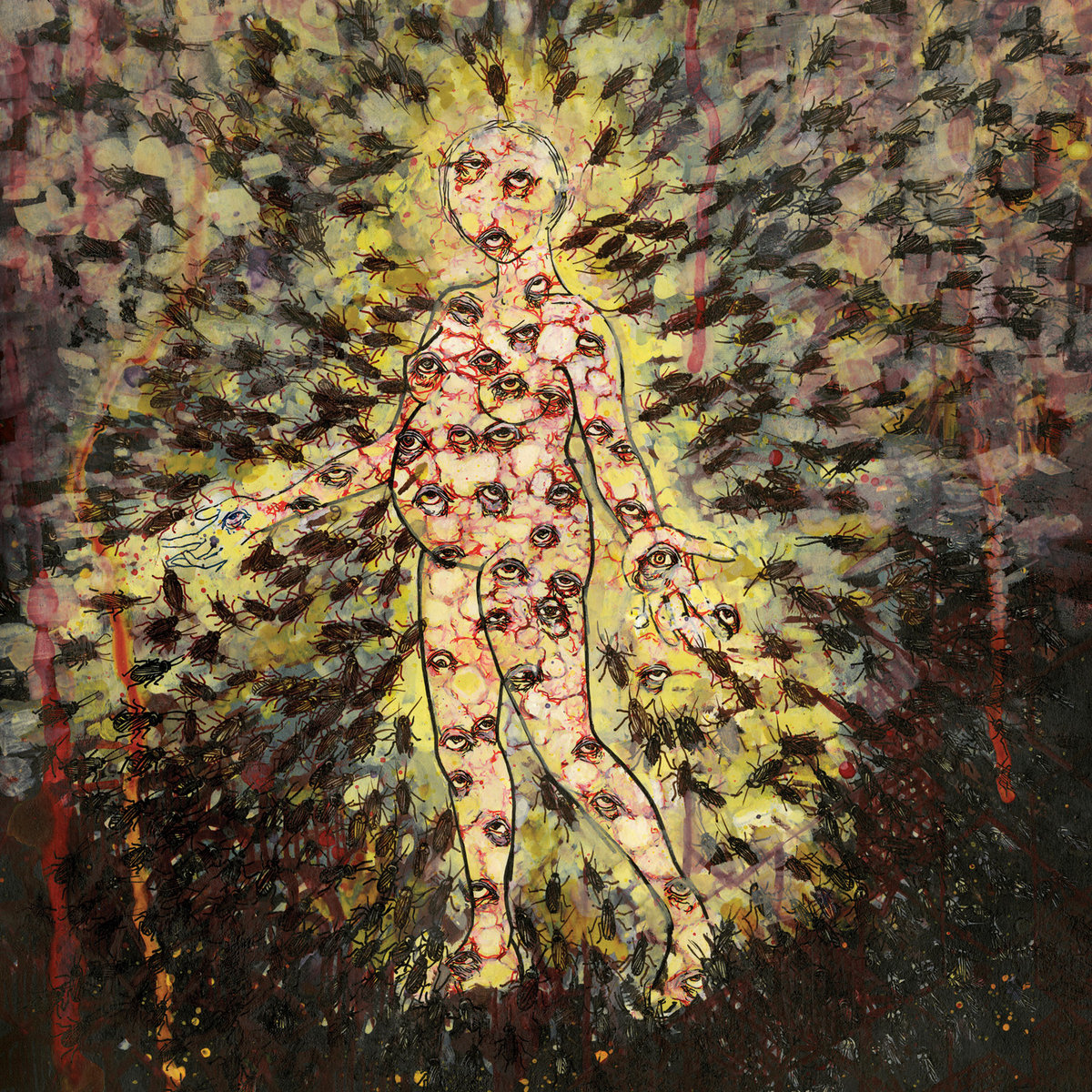
The album art is what reflects the nature of the album, an organic and festering husk of infested flesh, writhing in abject agony as it wails ceaselessly at the torment it has suffered. The lyrics are also particularly well written for death metal fitting both the music and the theme of the album extremely well, dealing primarily with the ugliest aspects of living that plague modern man but don't get talked about, things that skulk behind closed doors and things that are draped over with black veils. Most notable in this array of disturbing tales are the tracks Invisible Injury and the title track, the former dealing with the subject matter of the ramifications of intense beauty treatments, and the latter being a disturbing look at human fecundity and the ultimate fate of the world, the world will basically suffer a cataclysmic orgy and drown in semen, is basically what the lyrics are put in a very badly written and concise way.
The music, which I have yet to address, is composed of D-standard tuned guitar that is played with an array of alien, angular and maddeningly complex chords, slides and whammy bar molestation, vocals that range from typical death metal growling to a surprisingly unique mid-register bestial snarl that simply DRIPS with venomous hatred, complex and rewarding drum-work and, last but most definitely not least, audible bass! Amazing, it happened! And not obnoxious fretless bass noodling, just good crunchy BASS.
But you know what else this music avoids that most extreme metal isn't avoiding - thanks Fallujah/Immolation/blah blah, even though I love you all, I am looking at you right now - and turns it into something wonderful? Good production, handled by none other than Ryan Jones and underground metal genius Colin Marston, who creates easily my favourite production job of 2014, a resonating, dirty and not-quite-as-cavernous-as-Incantation-but-cavernous-enough-to-simply-breathe-dynamic-range production job, quite similar to all of the Flourishing releases and the recent Gorguts album Colored Sands actually, which is not surprising since Colin both produced and played on that album, which was also fucking amazing by the way.
The dynamic range on this album is simply fantastic, the music can breathe in a way that the majority of modern extreme metal is overly keen to avoid, drowning you in noodling, riffs and endless blasts beats, which was novel and cool for a while but, it's been a few years and every band is becoming indistinguishable from the rest, which renders releases like Mother of Virtues a very hopeful breath of fresh, albeit, disgusting air that I absolutely adore and hope to hear more of.
The album from start to finish changes from maddeningly heavy and dense passages, to very Ulcerate-ish moments that wash over you like a sickly black river, urging you to drown in it, as it eventually comes back to blistering heaviness with a startling speed to immediately flay you alive. And as I mentioned about the dynamics before, the dynamics extend to the changes of atmosphere in the music, the melodies are dark as all hell, the bass is buzzing and unrepetantly angry, like a swarm of angry hornets, the drums either stampede towards you like raging animals or slowly stalk you in the darkness, and the vocals at one very notable point on the album, even become a normal, yet strained voice, aching to inform you; "this is the world, we have made for ourselves..."
The only fault in this album is that there is not as much exploration on some of the tracks as you would probably hope from my description, tracks such as "The Parasite in Winter" come across as kind of rote, and almost as if a filler-esque buildup to the title track, which I can't complain about because the track itself is highly enjoyable, it's just not quite as disgustingly magical as the rest of the album manages to be, however, this barely subtracts from the enjoyment of the album, we still have an absolute monster of an album on our plate here.
I wish to conclude with one statement, the only time this album sounds anywhere near close to "ripping off Obscura" is on the track "Sleeper Agent" which is easily one of the more "catchy" songs on the album if you can even say that. And if you think the album is that close to ripping off Obscura otherwise, well, I'm sorry but you probably missed that nothing on Obscura was structured in the same way as any song save one on this album, and the songwriting approach couldn't be any more different, I guess you just think any post-death is just bad Gorguts, and that makes me think that anything you are is just a bad fan of music with little insight.
Thank you.
Jalix the Cruel
1. The Oracle of Nassau 01:25
2. White Flag 09:42
3. Sleeper Agent 04:04
4. Balkanized 04:46
5. Eternity in a Breath 08:16
6. Implant Fever 04:33
7. Invisible Injury 06:54
8. The Parasite in Winter 04:17
9. The Mother of Virtues 10:35
Alex Cohen - drums
Dylan DiLella - electric guitar
Erik Malave - bass guitar
Doug Moore - vocals
https://www.youtube.com/watch?v=Cg6igS4Oz8I
SEED 15:00-22:00.
POLECAM!!!
[ Pokaż/Ukryj ]
Podgląd zawartości dostępny jest tylko dla zalogowanych użytkowników.
|



























![PYRRHON - EXHAUST (2024) [MP3@320] [FALLEN ANGEL]](./imgtorrent/2c5d1eae457e0f04bf12232bd1f7b9bc3d2cd894-polskie-torrenty.jpg "PYRRHON - EXHAUST (2024) [MP3@320] [FALLEN ANGEL]")
![PYRRHON - EXHAUST (2024) [WMA] [FALLEN ANGEL]](./imgtorrent/d8ce2f24b30d85a7dfcae9372108c3d8e17e6939-polskie-torrenty.jpg "PYRRHON - EXHAUST (2024) [WMA] [FALLEN ANGEL]")
![PYRRHON - THE MOTHER OF VIRTUES (2014) [MP3@320] [FALLEN ANGEL]](./imgtorrent/599b1c54c518ce1ca152da5912938e8d5d7fb112-polskie-torrenty.jpg "PYRRHON - THE MOTHER OF VIRTUES (2014) [MP3@320] [FALLEN ANGEL]")